
A Cracked Chimney Crown Is Oklahoma City's Most Overlooked Water Entry Point.
At Oklahoma Chimney Sweep Pro, we evaluate crown damage before recommending a repair method. Hairline cracks, partial splits, and fully deteriorated crowns each require a different fix - and we document what we find before any material is applied.
- HairlineSurface-levelElastomeric resurfacing
- Partial splitInto the substrateReplacement
- Full failureStructural separationReplacement
OKC's Climate and Building Stock Create Specific Crown Failure Patterns.
Oklahoma City's freeze-thaw pattern is more aggressive than most homeowners realize. A single February day can swing 40 degrees - above freezing by noon, below it by midnight. That cycle repeats dozens of times each winter.
Here's what most homeowners don't realize about OKC chimney crowns: the failure rate isn't uniform across the city. Older central neighborhoods like Mesta Park and Crown Heights often have crowns that were poured without proper overhang dimensions - meaning water still drips onto the masonry face even when the crown is intact. Newer suburban builds in areas like Edmond-adjacent zip codes sometimes have thinner crowns that crack faster under thermal stress.
Our crew has worked across Oklahoma City year-round since 2016. We've seen how different neighborhoods experience crown failures at different rates and for different reasons. That local pattern knowledge shapes how we assess every job.
What Actually Happens Inside a Chimney Crown When It Freezes
Water inside a crown crack doesn't just sit there - it works.
I've pulled cracked crowns apart on jobs across OKC, and the damage is almost always worse than it looks from ground level. Here's the process, plain and simple.
A hairline crack - surface-level, barely visible - collects water every time it rains. In a warm-weather state, that might just mean slow staining. In Oklahoma City, that water freezes. Water expands roughly 9 percent when it turns to ice. Inside a tight crack, that expansion has nowhere to go except outward. This is freeze-thaw spalling - the physical breakdown of concrete caused by water repeatedly freezing and expanding inside existing cracks or pores.
By the second winter, a hairline becomes a partial split - one that penetrates into the substrate of the crown, not just the surface. By the third, you may be looking at full structural separation. At that point, we're not talking about resurfacing. We're talking replacement.
- Winter 1HairlineWater expands about 9 percent as it freezes
- Winter 2Partial splitInto the substrate of the crown
- Winter 3Full separationReplacement, not resurfacing
I walked a homeowner in northwest OKC through this exact progression last spring. She'd seen a small line across the top of her crown on a ladder inspection two years earlier and figured it wasn't urgent. When we got up there, the crack had split clean across the full width of the crown. Water had been hitting the top of the firebox every time it rained. The right call was a full crown replacement - not a patch. We documented the before condition, pulled the failed crown, and formed a new one to NFPA 211 crown overhang standard, which requires at least 2.5 inches of overhang on all sides to direct water clear of the masonry face.
The repair held through last winter. That's the difference between matching the repair method to the actual damage level and defaulting to whatever's fastest.
Oklahoma Chimney Sweep Pro Field Team, Oklahoma City
- Crack split clean across the full width
- Water reaching the top of the firebox
- Before condition documented
- New crown formed with overhang on all sides
You'll Know Exactly What Was Found Before We Start Any Repair.
Every chimney crown repair we do begins with a documented damage assessment - not a guess.
Crown crack classification - the process of categorizing damage as hairline, partial split, or full failure - determines which repair method is appropriate. We don't apply a resurfacing product to a crown that needs replacement. We don't recommend full replacement when a targeted repair will hold.
Before we apply a single thing, we document the damage condition with photos and a written description. You see what we see. That documentation also becomes your record - useful if you're selling the home, filing an insurance claim, or simply want to know what was done and when.
There's no guesswork in our repair recommendation. The damage tells us what it needs.
Our Standards for Chimney Crown Repair in Oklahoma City
Every crown repair we complete meets specific material and dimensional standards.
- Crown resurfacing uses flexible, elastomeric materials rated for exposure to OKC's thermal swing range
- Full crown replacement is formed with correct overhang dimensions per NFPA 211 - minimum 2.5 inches beyond the chimney face on all sides
- All crown surfaces are cleaned and prepped before any material is applied - adhesion depends on a clean substrate
- Damage condition is photographed before and after repair at every job
- New and resurfaced crowns are allowed proper cure time before weather exposure testing
- We do not apply patch materials over active structural separation - full failure means full replacement
How We Handle Chimney Crown Repair From Start to Finish
Our crown repair process follows a clear three-phase sequence.
- 1
Diagnostics
We start with a full visual inspection of the crown from the roofline - not just a ground-level look. We classify the damage: hairline crack, partial split, or full failure requiring crown replacement. We check the overhang dimensions against NFPA 211 standards. We also check the crown-to-flue junction, which is a separate water entry point that can be missed when only the crown surface is evaluated. All findings are documented with photos before work begins.
- 2
Implementation
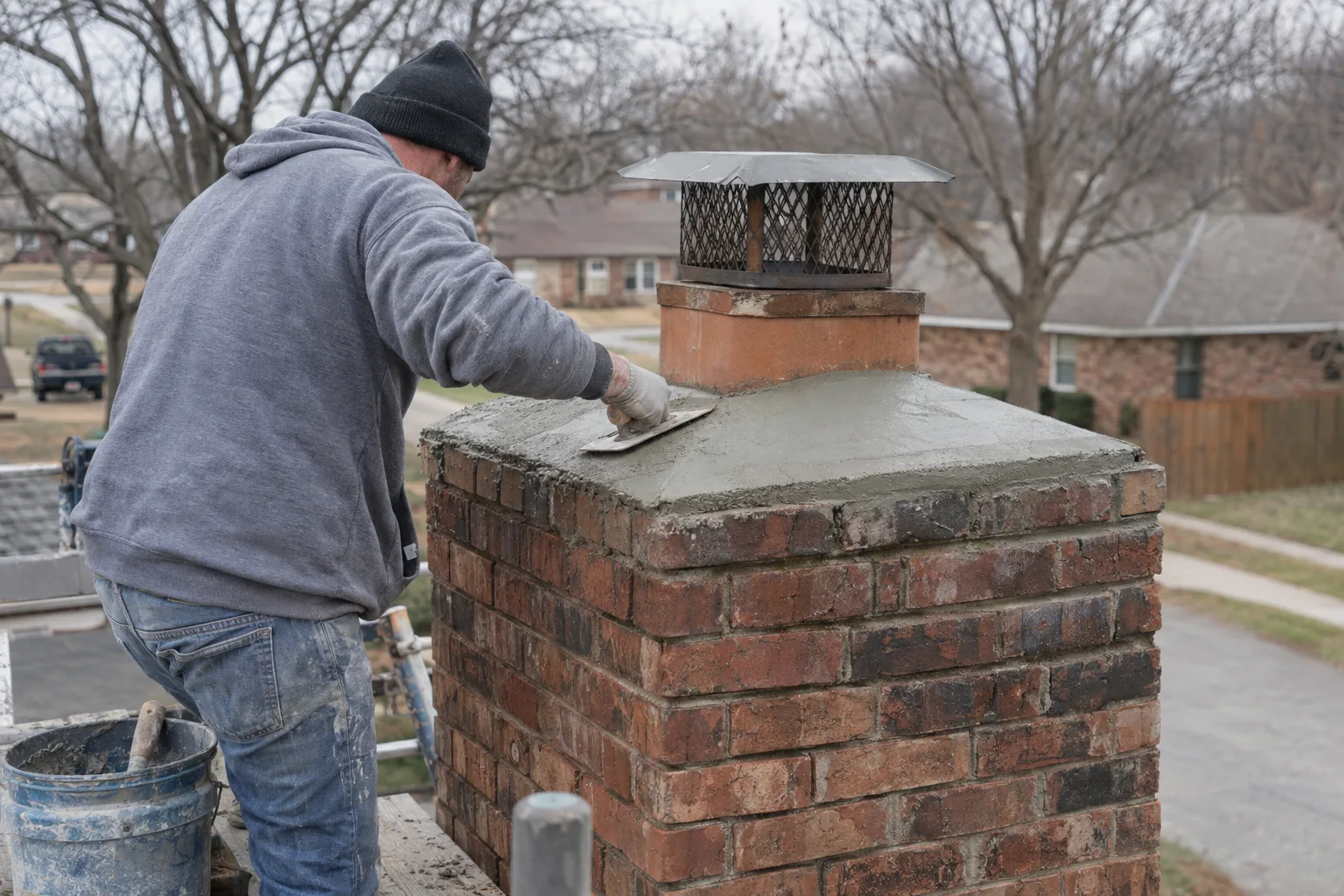
For hairline and surface-level cracks, we apply an elastomeric crown resurfacing product that bonds to the existing crown and creates a flexible, waterproof layer. Flexible matters in OKC - a rigid patch cracks again when the crown shifts with temperature. For partial splits and full structural failure, we remove the existing crown material, clean the chimney top, and pour a new concrete crown formed to correct overhang dimensions. Flue tile clearance is maintained throughout.
- 3
Post-Service Testing
After resurfacing, we check adhesion at the crown edges and around the flue collar - two spots where failure most often starts. After replacement, we verify overhang dimensions are correct on all four sides and that the crown-to-flue seal is solid. You receive a written summary of what was repaired, which method was used, and what condition the crown is in as of the service date.
Chimney Crown Repair Service Area - Oklahoma City
Oklahoma Chimney Sweep Pro serves Oklahoma City and surrounding communities. We work across OKC neighborhoods including Mesta Park, Crown Heights, Nichols Hills, Midtown, The Paseo, Capitol Hill, and outlying areas throughout the metro. If you're in the Oklahoma City area and have a crown question, we can get a crew there.
- Oklahoma City
- Mesta Park
- Crown Heights
- Nichols Hills
- Midtown
- The Paseo
- Capitol Hill
Chimney crown repair questions
How much does chimney crown repair cost in Oklahoma City?
Crown repair cost depends on damage severity. Hairline crack resurfacing costs less than a full crown replacement. Resurfacing is typically a single-visit fix. Full replacement requires forming and pouring a new concrete crown to correct dimensions. We document the damage condition before quoting, so you receive a price tied to actual findings - not a guess from ground level.
Can a cracked chimney crown be resurfaced, or does it always need full replacement?
Resurfacing works for hairline and surface-level cracks where the substrate is still structurally sound. Partial splits that penetrate the crown body and full structural separation require replacement - resurfacing over active separation fails quickly. We classify the damage first, then match the repair method to what's actually there. Applying the wrong method costs more in the long run.
How long does chimney crown repair take from inspection to finished job?
Most crown repairs are completed in a single visit. Resurfacing takes less time than replacement. Full crown replacement requires cure time before weather exposure - we factor that into scheduling. You receive a written summary of what was repaired and the crown's condition before we leave the job.
Why does my chimney crown keep cracking even after it was patched before?
Rigid patch materials fail in Oklahoma City's climate because the crown shifts with temperature swings. When a rigid filler can't flex, it cracks again at the same spot. We use elastomeric resurfacing materials rated for thermal movement - flexible enough to hold through OKC's freeze-thaw cycles without re-cracking at the repaired area.
What's the difference between crown resurfacing and crown replacement - and how do I know which one I'm getting?
Resurfacing applies a flexible waterproof layer over the existing crown surface. Replacement removes the failed crown entirely and pours a new one. You'll know exactly which one you're getting because we photograph and document the damage before any work starts. The repair method is explained in writing - not decided after we're already on the roof.
Does the crown overhang dimension actually matter, or is that just a technical detail?
Overhang dimension is one of the most common reasons OKC crowns fail prematurely. A crown that doesn't extend at least 2.5 inches beyond the chimney face on all sides allows water to drip directly onto the masonry below. NFPA 211 sets this as a minimum standard. Replacement crowns we form meet that dimension on all four sides - undersized crowns are a design flaw, not just wear.