
White Staining on Your Chimney Is a Readable Clue - Not Just a Stain
Efflorescence diagnostics is the process of reading white mineral staining to identify where water is entering your chimney.
Salt doesn't appear on a masonry surface without a reason. Water carries dissolved salts through brick and mortar. When it reaches the surface and evaporates, it leaves those minerals behind as a white deposit. That deposit - efflorescence - tells a trained technician something specific about the water's path, the entry point driving it, and whether the problem is still active right now.
Oklahoma City homeowners often see this staining and aren't sure what it means. The stain itself looks identical whether your chimney had one damp season and dried out completely, or whether water is actively pushing through a cracked crown right now. That's the uncertainty a diagnostic visit is designed to resolve - with a written finding, not a guess.
Oklahoma City's Late-Summer Humidity Makes Staining Patterns Readable
OKC's seasonal humidity creates ideal conditions for reading efflorescence - and for catching active intrusion before it causes structural damage.
Oklahoma City runs through a reliable weather cycle that affects chimneys in a specific way. Late summer brings humidity levels that drive moisture migration through masonry even without direct rainfall. Brick absorbs ambient moisture. Salts move with it. By early fall, that moisture begins to dry - and the surface staining it leaves behind is at its most visible and most diagnostic.
Here's what most homeowners don't realize about OKC's climate. The same seasonal drying that makes staining visible also makes it easier to distinguish active crystallization from old, dried deposits. Oklahoma Chimney Sweep Pro schedules efflorescence diagnostic visits heavily in late summer and early fall for exactly this reason. That timing window gives technicians the clearest read on what the staining is actually telling you.
Reading the Pattern: What Four Common Staining Scenarios Actually Mean
Every staining pattern has a different story - here's how a diagnostic technician reads each one.
I've been doing chimney diagnostics in Oklahoma City since 2016, and the most common mistake I see homeowners make is treating efflorescence as a single problem with a single fix. It isn't. Where the staining appears, how it spreads, and whether the deposits are dry or actively forming - those details tell completely different stories. Let me walk you through what I look for.
- 1
Staining concentrated below a single mortar joint.
This is one of the more precise patterns. When white deposits cluster directly beneath a horizontal or vertical joint, the salt migration path is short. Water is entering through that specific joint - either because the mortar has recessed, cracked, or lost its bond with the brick face. The staining fan is narrow. It doesn't spread widely across adjacent courses. That concentration tells us the water pathway is tight and localized, not a broad infiltration event.
- 2
Fan-shaped staining from the crown area.
When efflorescence spreads downward from the top of the chimney in a widening fan - broader at the bottom, originating near the crown - the probable source is above. A cracked chimney crown or a deteriorated crown edge allows water to run down the chimney face in a sheet pattern. Salts migrate with that sheet and deposit across a wide surface area as the water evaporates. This is one of the wider staining footprints I encounter.
- 3
Staining aligned with a flashing seam.
The chimney flashing is where the masonry meets the roofline. When efflorescence deposits appear in a horizontal line that tracks a flashing seam - particularly on the front face of the chimney - the most likely water pathway is a separated or corroded flashing joint. OKC's thermal expansion cycles stress these seams repeatedly across the year. The staining pattern here is often thin and linear rather than broad.
- 4
Uniform staining across the full chimney face.
This is the pattern that warrants the most careful reading. When deposits appear evenly across a large section of the chimney face - not concentrated near any single joint, crown, or seam - it typically indicates either widespread mortar saturation or a waterproofing failure that's allowing broad surface absorption. In some OKC homes built before the 1980s, original brick was softer and more porous than modern materials. Full-face efflorescence on older brick often means the masonry itself is absorbing and releasing moisture across its entire surface area, not through a single entry point.
Distinguishing active vs. historical efflorescence - the two fundamental states of any deposit - is what separates a surface cleaning decision from a structural repair decision. Active efflorescence shows loose, lacy crystallization that may feel slightly damp. Historical efflorescence is hardened, chalky, and bone dry. Both are white. They require entirely different responses.
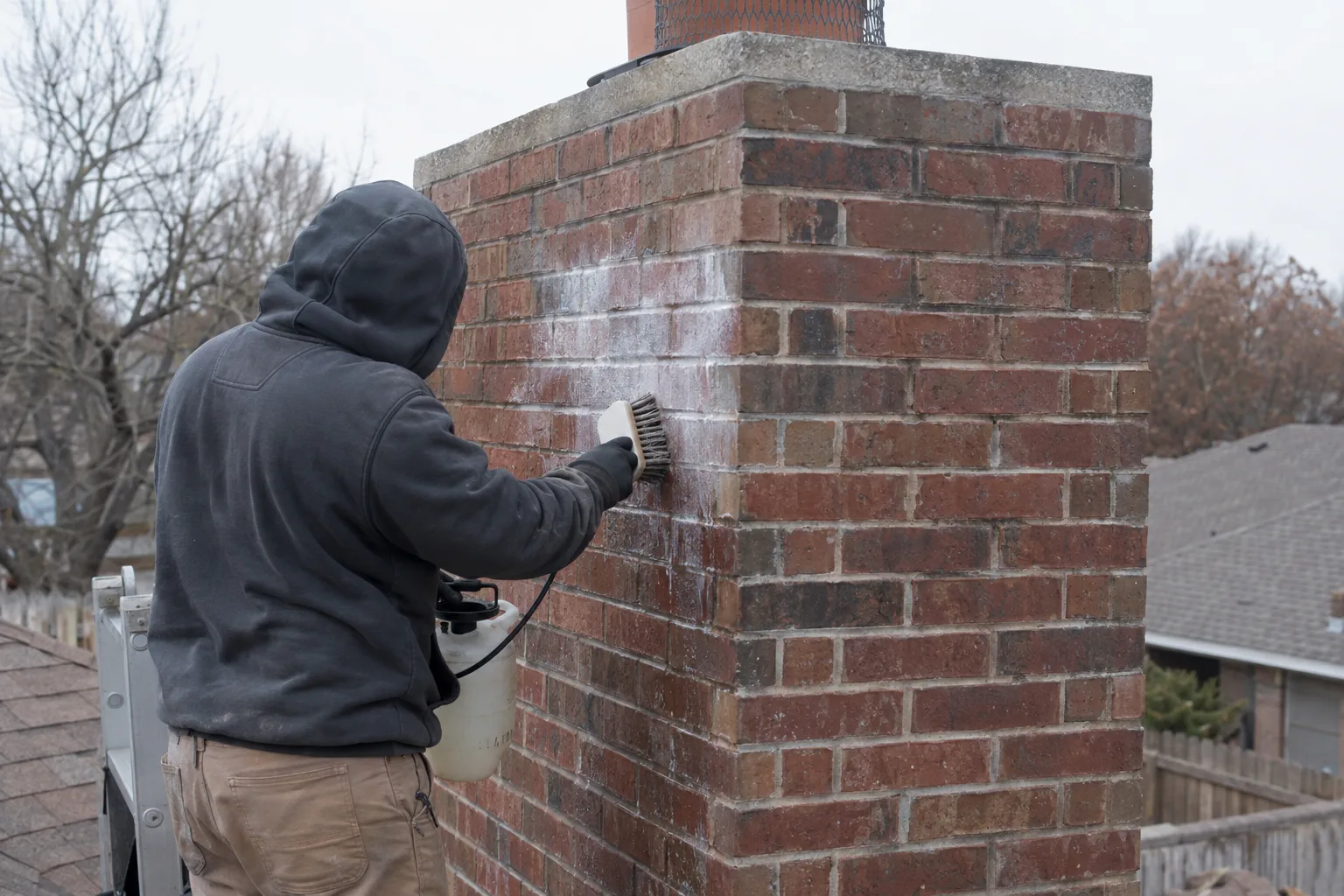
Water pathway mapping - the process of tracing visible surface symptoms back to a specific structural entry point - is what the diagnostic report documents. The written finding I produce after each visit names the staining pattern observed, its probable source, and the next logical step. It is not a repair proposal. It's a documented read of what the chimney is telling you.
The Written Finding Is Separate From Any Repair Recommendation
You get a diagnostic report first - a clear document that tells you what we found and why.
A lot of homeowners are surprised that the diagnostic visit produces its own document. Most service calls in this trade fold the diagnosis into the job estimate. We don't do that here.
The diagnostic report - the written finding that names the staining pattern, the probable moisture intrusion source, and the recommended next step - stands alone. That matters for one specific reason. If the finding points to a failed flashing seam, the repair that follows should target the flashing. If it points to mortar joint failure on the north face, repointing those joints is the right response. When the diagnosis and the repair proposal are bundled together, there's no clear record of what was actually observed. You're making repair decisions without a documented baseline. Our process keeps those steps separate so that any follow-up work is traceable to a specific, written finding.
- Pattern
- Fan-shaped, crown origin
- State
- Active loose, damp crystals
- Probable source
- Cracked crown edge
- Next step
- Follow-up inspection of the crown
Example of the fields every report names.
What Our Efflorescence Diagnostic Standards Cover
Our diagnostic standard covers pattern type, moisture state, location mapping, and a written finding - every visit.
Here's what every efflorescence diagnostic visit includes:
- Staining pattern classification joint-concentrated, crown-origin fan, flashing-aligned linear, or full-face
- Salt crystallization state assessment active (loose, damp crystal formation) vs. historical (hardened, chalky, dry deposit)
- Moisture intrusion source probability mapping connecting the staining pattern to crown, mortar joint, flashing, or surface absorption as the most likely water pathway
- Chimney face quadrant documentation noting which elevation and height band the staining occupies, since north-facing surfaces in OKC hold moisture longer and often show more concentrated deposits
- Written diagnostic report a separate document from any repair estimate, naming the finding and the recommended next step
Three things we don't do: guess at the source without reading the pattern, offer a repair quote before documenting the diagnosis, or treat all efflorescence as the same condition requiring the same response.
How the Diagnostic Visit Works
The efflorescence diagnostic follows a three-phase process - observation, interpretation, and documented finding.
- 1
Phase 1: Diagnostics
The technician arrives and begins with a full visual survey of all four chimney faces. We're looking at staining location relative to structural features - crown edge, mortar joints, flashing seam, and brick face. We note which deposits are in active crystallization state and which are historical. We photograph each pattern with reference markers so location can be documented precisely. At this phase, we're gathering data - not drawing conclusions yet.
- 2
Phase 2: Interpretation and Water Pathway Mapping
With the full pattern observed, the technician works through the crown, joint, and flashing cross-reference - the three most common structural moisture sources in OKC construction. Each staining pattern is matched to its most probable origin point. Fan-shaped from the crown? Crown is the candidate. Thin horizontal line at flashing height? Flashing seam is the candidate. Narrow deposit below a single joint course? That joint is the candidate. In ambiguous cases - particularly full-face staining on older brick - we note multiple probable contributors and rank them by likelihood.
- 3
Phase 3: Written Finding and Next Steps
The visit closes with a written diagnostic report. It names the staining pattern type, the probable moisture intrusion source, the crystallization state at the time of inspection, and a recommended next step. That next step might be efflorescence removal, a targeted repair, or a follow-up inspection of a specific structural component. The report is yours. It's the documented baseline for whatever comes next.
Neighborhoods We Serve in Oklahoma City
Oklahoma Chimney Sweep Pro schedules efflorescence diagnostic visits across the Oklahoma City metro.
We serve homeowners throughout Oklahoma City, including Edmond, Yukon, Mustang, Moore, Midwest City, Del City, Bethany, and surrounding communities. If you're in the OKC metro and seeing white staining on your chimney, we can schedule a diagnostic visit. Call (405) 451-4866 or email info@okchimneysweep.com to confirm coverage for your address.
- Oklahoma City
- Edmond
- Yukon
- Mustang
- Moore
- Midwest City
- Del City
- Bethany
Efflorescence diagnostics questions
What exactly does the diagnostic report include - and is it a repair quote?
The written finding is not a repair quote. It names the staining pattern type, the moisture crystallization state, and the most probable water entry point. Those three items give you a documented baseline before any repair decision is made. A repair estimate comes separately, only if one is needed.
Can't I just clean the white staining off and skip the diagnosis?
Cleaning removes the deposit - it does not remove the water source driving it. If active moisture is still moving through the masonry, new staining returns within one to two seasons. Skipping the diagnostic step means any cleaning or repair work targets the symptom, not the cause. That's the core reason the diagnostic visit runs first.
What makes reading the staining pattern different from a standard chimney inspection?
Standard inspections assess structural condition across the whole chimney system. Efflorescence diagnostics focus on one specific question: where is water entering, and is it still active? The technician interprets pattern shape, deposit location, and crystallization state as a set - not as individual data points. That focused read produces a more specific answer than a general inspection delivers.
Do I need a separate inspection scheduled before the efflorescence diagnostic, or is this a standalone visit?
This is a standalone service. No prior inspection is required to schedule an efflorescence diagnostic visit. If the written finding points to a structural issue - a cracked crown or failed flashing seam - a follow-up inspection of that specific component may be recommended. That recommendation comes from the report, not as a condition of booking.