
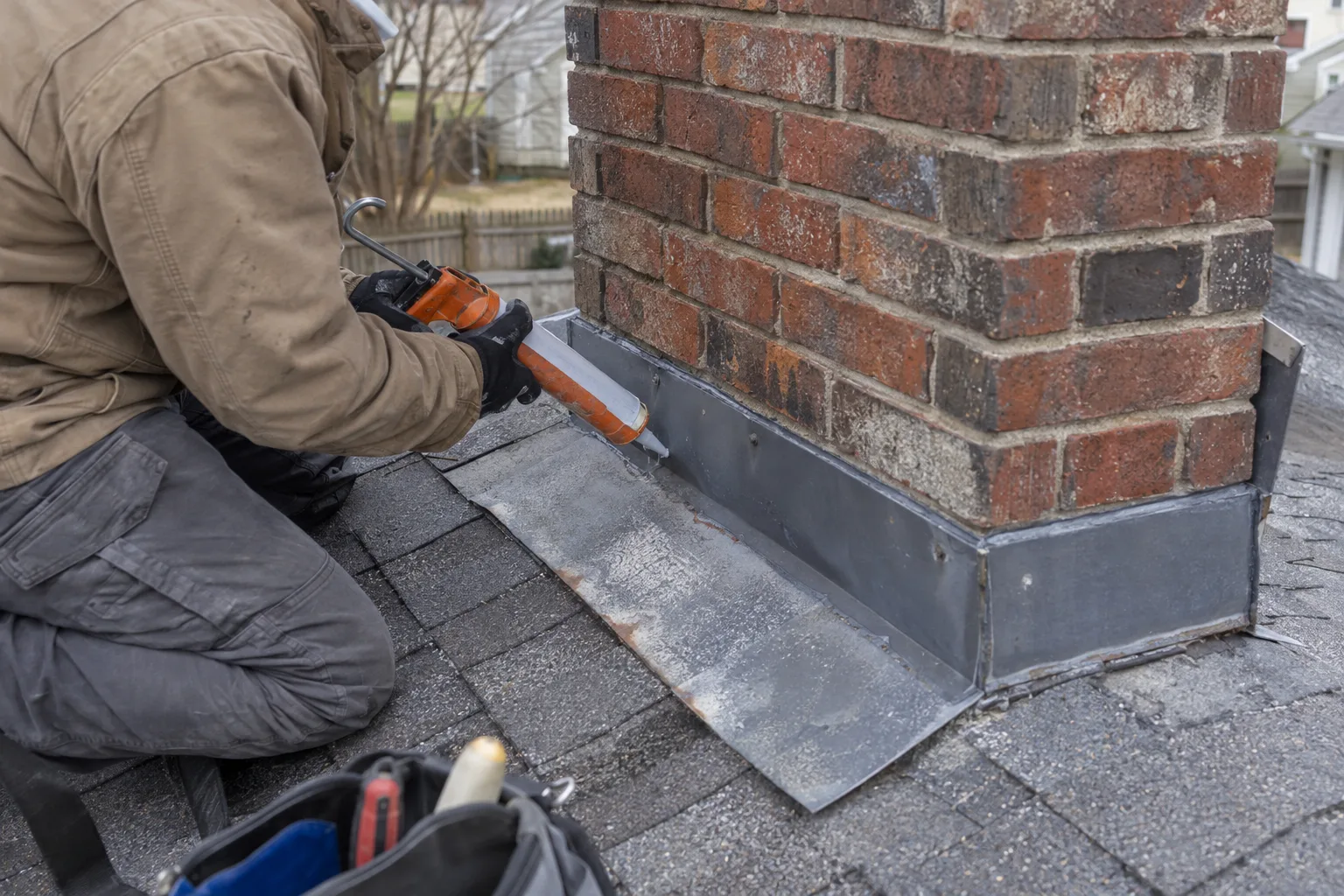
# Chimney Flashing Repair in Oklahoma City, OK
Chimney Flashing Repair Fixes the Most Overlooked Leak Point on Your Roof
A ceiling stain near your fireplace usually points to one place: the flashing joint, not the chimney itself.
Oklahoma City's Storm Climate Creates a Specific Flashing Problem
OKC hailstorms target counter flashing in a predictable way - and our team has seen it across multiple storm seasons.
Here's what most homeowners don't realize about hail damage to flashing. The impact doesn't punch a hole. It bends or lifts the counter flashing - the metal layer sealed against the chimney - away from the masonry. That creates flashing separation: a gap between the metal and the mortar joint that looks tight from the ground but channels every rainstorm straight into the roof deck below your shingles.
Oklahoma City's hail season runs April through June, and thermal cycling - the expansion and contraction of metal as temperatures swing from 100°F summers to sub-freezing winters - keeps those gaps from closing on their own. Our technicians have worked OKC rooflines since 2016. They know the flashing geometry on post-WWII ranch-style homes near the Paseo District is different from the steeper two-story profiles common in Edmond-adjacent neighborhoods. Those differences shape where the failure starts.
What I Actually Find When I Get on the Roof
Most flashing calls start with a ceiling stain - and the real problem is always deeper than it looks from below.
I've been on hundreds of OKC roofs since 2016, and I want to walk you through what a real flashing call looks like.
A homeowner calls after a hailstorm in May. There's a brown water stain on the ceiling about two feet from the fireplace. They're convinced the chimney crown is cracked - that's the first guess almost every time. I get on the roof and check the crown first. It's solid. Then I move to the flashing.
On a 1990s two-story in Moore, I found the counter flashing on the left side had lifted a quarter-inch off the mortar reglet - the horizontal slot cut into the chimney masonry where the metal is embedded and secured. The step flashing underneath was intact. But because that counter flashing had separated, every rainfall was running behind it, soaking the felt underlayment, and sitting on the roof deck until it found the ceiling below.
The mortar in the reglet had dried out. No hail crack, no shingle failure. Just a compromised mortar reglet from years of thermal cycling, and one storm big enough to finish the job.
A caulk-only repair - applying sealant over the gap without re-embedding the metal - would have held for one season. Maybe two if we got lucky with a mild spring. Instead, we pulled the counter flashing, cleaned the reglet, reset the metal with proper anchoring, and sealed it correctly. That repair holds.
That's what we find most of the time. Not a catastrophic failure. A specific, fixable gap at the mortar line.
A Caulk Patch Is a Temporary Fix - Here's What a Permanent One Looks Like
The difference between a lasting chimney flashing repair and a recurring leak is where the fix starts.
A caulk-only repair fills the visible surface gap. It doesn't re-anchor the metal. In OKC's climate, thermal cycling works that sealant loose within one to two storm seasons. The gap reopens. Roof deck water intrusion - water bypassing the roofing system through a flashing failure and saturating the structural deck below the shingles - starts again.
| What Doesn't Last | What Does |
|---|---|
| Surface caulk over lifted counter flashing | Counter flashing removed, reglet cleaned, metal re-bedded |
| Sealant applied without checking step flashing condition | Both flashing layers inspected and addressed |
| No attention to the mortar reglet | Reglet re-pointed and properly anchored before resealing |
We address both layers - always. If the step flashing woven into your shingles is compromised, fixing only the counter flashing above it moves the leak point, not the leak.
Our Standards for Chimney Flashing Repair
Every flashing repair we do meets the same standard - both layers, both sides, confirmed dry before we leave.
- Two-layer inspection:We check step flashing and counter flashing independently before any repair begins.
- Mortar reglet assessment:We probe the reglet for voids, cracks, and loose material - not just surface condition.
- Metal integrity check:Flashing that's bent, corroded, or thinned from hail impact gets replaced, not re-bent.
- Proper embedment:Counter flashing is re-seated into the reglet with fresh mortar, not surface sealant.
- Step flashing weave verified:We confirm the step flashing is correctly integrated with existing shingles on both sides.
- Sealant as a finish, not a fix:Sealant is applied only after the metal is correctly embedded and anchored.
- Dry-in confirmed:We don't close a job until both flashing layers are confirmed sealed and watertight.
Our Chimney Flashing Repair Process
From first look to final seal, here's exactly how we work a flashing repair in Oklahoma City.
Diagnostics
We start on the roof. A technician inspects the full flashing system - step flashing along both sides and counter flashing on the front and back apron. We probe the mortar reglet for depth and adhesion. We also check the chimney crown and upper masonry while we're up there, because water doesn't always come from one place. You get a clear verbal and written report of what we found before any work begins.
Implementation
Repair scope depends on what diagnostics reveal. If counter flashing has separated from the mortar reglet, we remove it, clean the reglet channel, re-point the mortar, and re-embed the metal with proper anchoring. Damaged step flashing sections are removed and replaced course by course, woven correctly into the shingle line. We use galvanized or stainless steel flashing material - appropriate for OKC's thermal cycling range - and finish with a compatible sealant rated for masonry-to-metal contact.
Post-Service Testing
Before we pack up, we run a water test. We introduce water at the upper flashing line and watch for any movement through the system. We also walk the interior to compare the ceiling area against the pre-repair baseline. You know the result before we leave the driveway.
Areas We Serve in Oklahoma City
Oklahoma Chimney Sweep Pro serves homeowners and property owners throughout Oklahoma City, OK.
We work across Oklahoma City and the surrounding communities. That includes neighborhoods throughout the metro, from established midtown areas to newer suburban developments. If you're in the greater OKC area, we're in your zip code. Call us at (405) 451-4866 to confirm your address and schedule.
Ready to Fix Your Chimney Flashing? Here's How to Reach Us
A proper chimney flashing repair in Oklahoma City starts with a roof-level inspection - and we're ready to schedule yours.
Call Oklahoma Chimney Sweep Pro at (405) 451-4866 or email info@okchimneysweep.com. Let us know where you're seeing the stain, when it started, and whether you had a recent storm. We'll schedule your inspection and walk you through exactly what we find.