A Chimney Leak Inspection Finds Exactly Where Water Enters - Before Any Repair Begins
A chimney leak inspection is a structured diagnostic process that traces water intrusion to its confirmed source.
Water intrusion pathway - the specific route water takes through a chimney system - determines every repair decision. That pathway could be a cracked chimney crown, a failed flashing seam, deteriorating mortar joints, or porous brick absorbing moisture after heavy rain. Each one looks different. Each one requires a different fix. Oklahoma Chimney Sweep Pro runs a full multi-point diagnostic across all four entry zones. We identify the source in writing before any repair scope is produced. Homeowners across Oklahoma City get a clear answer - not a guess.
1Cracked chimney crownWater channels down inside the masonry
2Failed flashing seamWhere the chimney meets the roof
3Deteriorating mortar jointsErosion lets water wick in
4Porous brickAbsorbs moisture after heavy rain
OKC's Spring Storms Create Specific, Recurring Leak Profiles
Oklahoma City's storm season is one of the most predictable chimney leak triggers in the region.
April and MayWind-driven rainHits chimney faces at angles flashing can't deflect
WinterFreeze-thawCracks what the storms softened
Next springWider cracksWater finds a new path every season
Wind-driven rain during April and May hits chimney faces at angles that standard flashing was never designed to deflect. That matters here specifically. OKC's housing stock - much of it built between the 1960s and 1990s - uses step flashing (L-shaped metal pieces layered between roof shingles and the chimney side) that has now aged past its typical service window.
Then winter arrives. The freeze-thaw cycle - repeated expansion and contraction of water inside masonry pores - cracks what the storms softened. By spring, those cracks are wider. Water finds a new path every season.
We've tracked these patterns across Oklahoma City since 2016. Certain neighborhoods near flood-prone creek corridors see persistent mortar joint deterioration. Areas with older cedar shake roofs that were converted to asphalt often have flashing that was never properly reset. Local pattern recognition is part of what makes this diagnostic accurate.
From the field
How a Multi-Point Leak Inspection Actually Unfolds in the Field
I've seen what looks like a flashing leak turn out to be a chimney crown issue on the other side of the stack.
Oklahoma Chimney Sweep Pro Crew Lead, Oklahoma City
On a visit last May, after a system that dropped two inches of rain in under an hour across the metro, I arrived at a home in southwest OKC. The homeowner had a ceiling stain about eight feet from the fireplace. He assumed the flashing had failed.
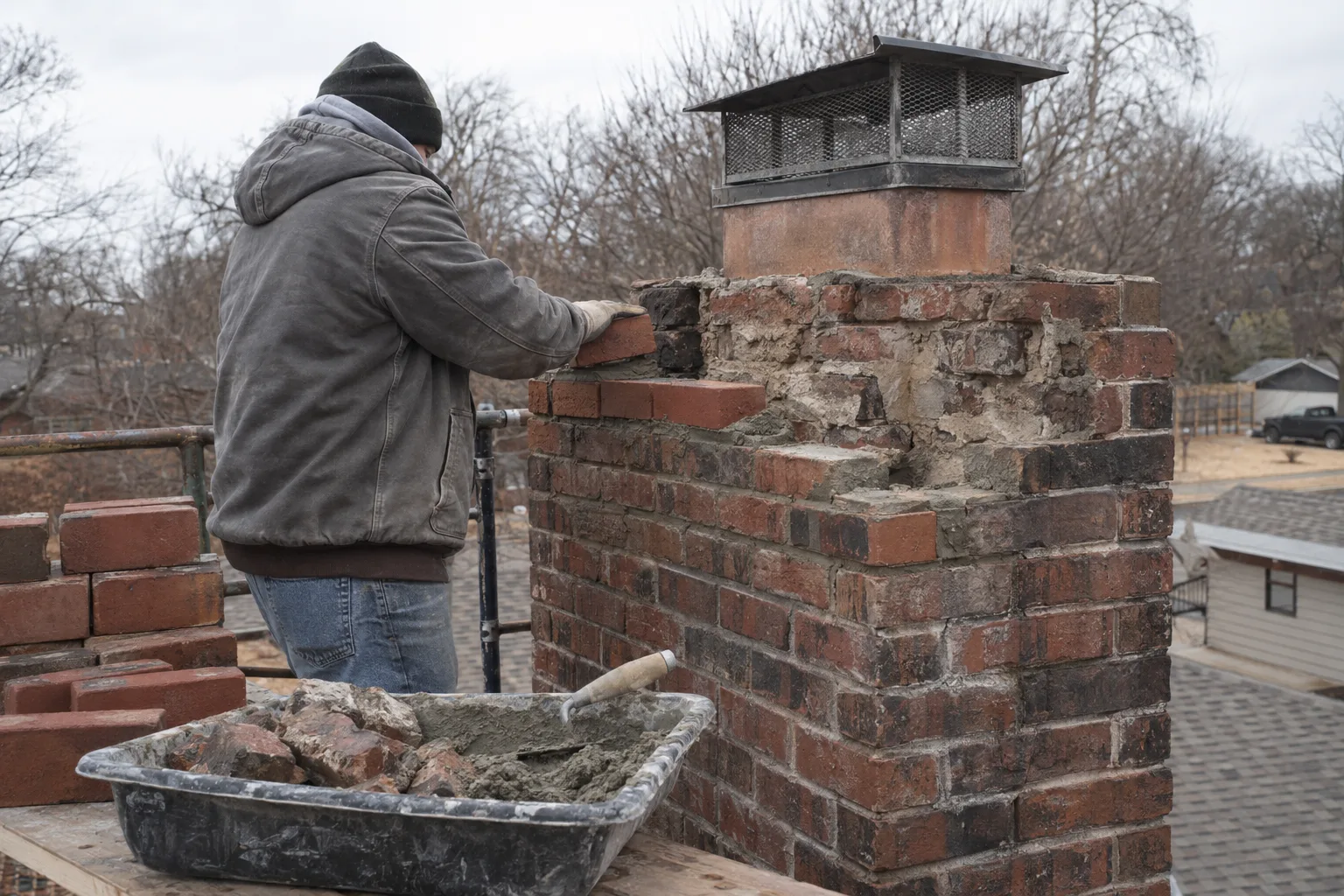
I started at the top. The chimney crown - the concrete cap that sits atop the chimney stack and sheds water away from the flue opening - had a hairline crack running east to west. That crack was absorbing rain, channeling it down inside the masonry. But I didn't stop there. Step flashing on the south face showed oxidation but no active gap. Mortar joint deterioration - the breakdown of the binding material between bricks - was visible on the north exposure, about three courses down from the crown. Two entry points. Moisture mapping (our process of reading staining patterns and damp readings to trace how far water has traveled) showed the ceiling stain was originating at the crown crack, not the mortar.
If we'd patched the mortar first, the ceiling stain would have returned. We confirmed the crown as the primary source. We documented both findings. The homeowner received a written report before we discussed any repair work. That's how this is supposed to go.
All findings are logged zone by zone as the inspection unfolds. Nothing is written up from memory at the truck.
Job reportSouthwest OKC, May
Trigger
Two inches of rain in under an hour
Symptom
Ceiling stain about eight feet from the fireplace
Assumed
Flashing failure
Crown
Primary hairline crack, east to west
Flashing
South face oxidized, no active gap
Mortar
Secondary north face, three courses down
Report
Written before any repair talk
Confirmed source
Supporting observations
Recommended repair path
You'll Know Exactly What We Found - In Writing - Before Anything Else Happens
No repair recommendation leaves our crew without a written diagnostic report confirming the source.
Here's what most homeowners don't realize about chimney water intrusion: two entry points can produce the same interior symptom. A ceiling stain near a fireplace could come from flashing, the crown, or porous brick face - and they all look identical from inside the house.
We don't guess. We don't offer a repair menu and let you pick. We confirm the water intrusion pathway in writing - including the evidence we used to reach that conclusion - and then we talk about next steps. Your diagnostic report includes the confirmed source, supporting observations, and a recommended repair path. That's what you hold in your hand when this visit is done.
Our Diagnostic Standards for Chimney Leak Inspections
Every inspection follows the same structured protocol - no shortcuts, no skipped zones.
Crown surface checked for cracks, edge separation, and slope failure
Step flashing examined for gap, rust, and improper overlap along all chimney faces
Mortar joints assessed for erosion depth and water-wicking capacity
Brick face evaluated for efflorescence (white mineral deposits left by water moving through masonry) and surface spalling
Interior firebox and smoke chamber checked for moisture and staining patterns
Moisture mapping used to trace travel distance from suspected entry points
All findings documented with written notes and, where applicable, photo documentation
Diagnostic report produced before repair scope is discussed
Oklahoma Chimney Sweep Pro has run this protocol across Oklahoma City since 2016 with a 10-person crew trained to read the same evidence consistently.
Our Chimney Leak Inspection Process - Start to Finish
Diagnostics
We begin at the top of the stack. Crown condition is the first check - surface cracks and edge gaps are common after OKC hail events. From there, we move to the flashing line on all four chimney faces. Step flashing and counter flashing are inspected separately. Mortar joint erosion is checked from the crown line down to the roofline. Brick porosity is assessed visually and by feel - saturated masonry has a distinct texture. All findings are logged as we work.
Implementation
Once all four zones are documented, moisture mapping begins. We cross-reference staining patterns inside the firebox with exterior findings to identify which pathway is active versus which shows historical exposure. This is where two entry points get ranked. The primary source is confirmed. Supporting evidence is written up. A diagnostic report is completed before we discuss any repair work.
Post-Service Testing
After the inspection is complete, we review the report with you in plain language. We walk through what we found, where we found it, and why we concluded what we did. If a repair is warranted, you'll understand the scope before we schedule it. No open-ended work orders. No surprise add-ons at the job site.
Chimney Leak Inspections Across Oklahoma City
Oklahoma Chimney Sweep Pro dispatches inspection crews across the full Oklahoma City metro.
We serve residential and commercial addresses throughout Oklahoma City, including the metro's north, south, east, and west corridors. Most scheduling requests are accommodated within a standard window - so a leak spotted after an OKC spring storm can be evaluated before the next system moves through. Contact us to confirm availability for your address.
North OKC
South OKC
East OKC
West OKC
Residential and commercial
Chimney leak inspection questions
What's the difference between a leak inspection and a standard chimney inspection?
A leak inspection targets one specific problem - active water intrusion - using moisture mapping and multi-point source confirmation. A standard inspection checks overall system condition without prioritizing a water entry investigation. Leak diagnostics produce a written report naming the confirmed entry point before any repair is discussed.
How long does the chimney leak diagnostic take from arrival to written report?
Most diagnostics are completed in one visit, typically within one to two hours on site. Crown, flashing, mortar joints, and brick face are all checked before moisture mapping begins. The written report is produced before any repair conversation happens - same day, same visit.
Can you inspect just the flashing if that's where I think the leak is?
Full multi-point inspection is the standard process - not a single-zone check. Flashing and crown failures produce identical interior symptoms. Inspecting only one zone risks missing the actual source, which means a repair that solves nothing. Every visit covers all four entry zones before a source is confirmed.
Will I receive anything in writing, or is the diagnosis verbal only?
Written documentation is part of every inspection - not an add-on. The diagnostic report names the confirmed water intrusion pathway, lists the supporting evidence, and outlines the recommended repair path. No repair scope is produced until that report is complete.
A chimney leak inspection from Oklahoma Chimney Sweep Pro ends with a written answer - not a recommendation based on assumption.
Water is already moving through your masonry. The question is which path it's taking. We find that path, confirm it in writing, and give you a clear picture of what repair - if any - is needed. Call us at (405) 451-4866 or email info@okchimneysweep.com to schedule your chimney moisture inspection in Oklahoma City.