A Properly Built Chimney Crown Is the First Line of Defense at Your Chimney Top
Oklahoma Chimney Sweep Pro installs custom concrete chimney crowns in Oklahoma City using cast-in-place concrete - mixed and poured on your specific chimney, not cut from a pre-made slab. Every crown we install meets NFPA 211 overhang and slope requirements. That means a minimum 2-inch drip edge and a surface pitched to drain water away from your flue, not toward it.
Oklahoma City's Weather Makes Crown Quality a Serious Structural Issue
OKC's temperature swings are among the most extreme of any major metro in the region. Summer highs push past 100°F. Winter lows drop well below freezing. That range is hard on concrete, especially thin concrete that wasn't built with thermal cycling in mind.
Thermal cycling - the repeated expansion and contraction a crown undergoes as temperatures swing - is the primary reason crowns fail in OKC faster than they might elsewhere. A crown with no drip edge overhang allows water to run down the chimney face directly. When that water freezes in the brick joints below, it expands and pries mortar loose. The damage doesn't stop at the crown.
Oklahoma Chimney Sweep Pro has been based in Oklahoma City since 2016. The crew works chimneys throughout the metro - from older Midtown homes built with original flat masonry crowns to newer southern-corridor construction where builder-grade crowns are already showing stress cracks after just a few winters.
Here's what most homeowners don't realize about crown failure: it's not always the material that gives out first. It's the geometry.
From the field
Why the Same Crack Came Back Two Years Later
A repaired crown that fails again usually wasn't repaired - it was patched. I've seen this pattern dozens of times across Oklahoma City, and it almost always comes down to the same two things: slope and overhang.
A homeowner in the Nichols Hills area called us after noticing a familiar brown stain returning on the inside of their firebox. They'd had chimney work done about two years earlier - the crown had been patched and sealed. It looked fine from the ground. But when we got to the top, the slope was essentially zero. The surface was nearly flat, slightly cupped in the center. Water was pooling directly over the flue tile and working through every hairline crack the freeze-thaw cycle had reopened.
The patch had covered the old cracks but didn't fix what caused them. The crown still had no drip edge overhang - maybe half an inch past the chimney face. And the concrete was less than an inch thick at the edges. Every time the temperature dropped below freezing, that thin perimeter flexed and cracked again.
We removed the existing crown down to the brick. We poured a new cast-in-place concrete crown with a confirmed slope of at least ¼ inch per foot toward the outer edge, a full 2-inch drip edge overhang, and a minimum thickness of 2 inches at the edge tapering up toward the flue. That crown directs water out and over the chimney face, not into it.
Two seasons later, the homeowner called for their annual cleaning. No new staining. No new cracks. That's what a properly built crown actually does - it stops the cycle instead of resetting it.
Your Existing Crown Can Be Assessed Before We Recommend Replacement
Not every crown needs a full replacement - and we'll tell you honestly which is which. If a crown has a sound base with only minor surface cracking and adequate slope already in place, a targeted repair may extend its service life significantly. We assess thickness, slope, drip edge projection, and surface integrity before recommending a course of action.
Here's how we handle the assessment: we get eyes on the crown directly - not just from the roofline, but from crown level. We check the overhang dimension, confirm the pitch using a level, and probe the surface for soft spots or delamination. If the existing crown meets NFPA 211 overhang specs and has solid concrete underneath, we talk repair. If it's thin, flat, or structurally compromised, a new custom pour is the right answer.
We're not going to recommend a pour when a repair will do. That's not how we build long-term customer relationships in Oklahoma City.
Our Standards for Every Concrete Chimney Crown We Install
Every chimney crown we install is built to hold - not just to look finished from the street.
Here's what that means in practice:
- Cast-in-place concrete only.No pre-fabricated crowns. Each crown is mixed and formed on-site to match the exact flue tile arrangement and chimney dimensions.
- Minimum 2-inch drip edge overhang.The projecting lip - or drip edge overhang - extends beyond the chimney face, keeping runoff from tracking down the masonry below.
- Confirmed crown slope before curing.A minimum pitch of ¼ inch per foot toward the outer edge is verified before the pour is considered complete.
- NFPA 211 compliance.NFPA 211 is the National Fire Protection Association standard governing chimney crown construction. Every crown we pour meets or exceeds those specifications.
- Minimum 2-inch thickness at perimeter edges.Thin edges are where freeze-thaw damage starts. We don't leave thin edges.
Pre-Fab vs. Cast-in-Place: A Direct Comparison
| Factor | Pre-Fabricated Crown | Cast-in-Place (Custom Pour) |
|---|---|---|
| Overhang Accuracy | Cut to approximate fit; gaps common on older OKC chimney profiles | Formed to exact chimney dimensions; 2-inch overhang confirmed |
| Slope Control | Fixed pitch; may not match existing chimney top geometry | Slope set and verified on-site before curing begins |
| Edge Thickness | Often thin at edges; susceptible to thermal cycling damage | Minimum 2 inches at perimeter; built for OKC freeze-thaw range |
| Fit on Irregular Flues | Poor; gaps require additional sealant | Excellent; conforms to multi-flue or non-standard arrangements |
| Longevity in OKC Climate | Shortened by freeze-thaw cycling where fit is imperfect | Maximized when slope, overhang, and thickness are all correct |
How a Crown Installation Works: The Day-of Process
A crown installation with Oklahoma Chimney Sweep Pro follows a clear, repeatable process. You'll know what's happening at every step.
Diagnostics
We start at the top of the chimney - not from the ground. The crew inspects the existing crown or crown remnants for thickness, slope, drip edge projection, and flue tile condition. We check the masonry below the crown line for any water infiltration already in progress. If there are concerns about the flue or the brick below, we document them before the pour begins. Chimney crown installation Oklahoma City work done right starts with a complete picture.
Implementation
1. The old crown is removed down to clean, stable brick. Any loose mortar or degraded concrete is cleared.
2. The chimney top is prepared - edges are squared and cleaned so the new concrete bonds properly to the masonry below.
3. Formwork is set to shape the overhang profile. This is where the drip edge geometry is established.
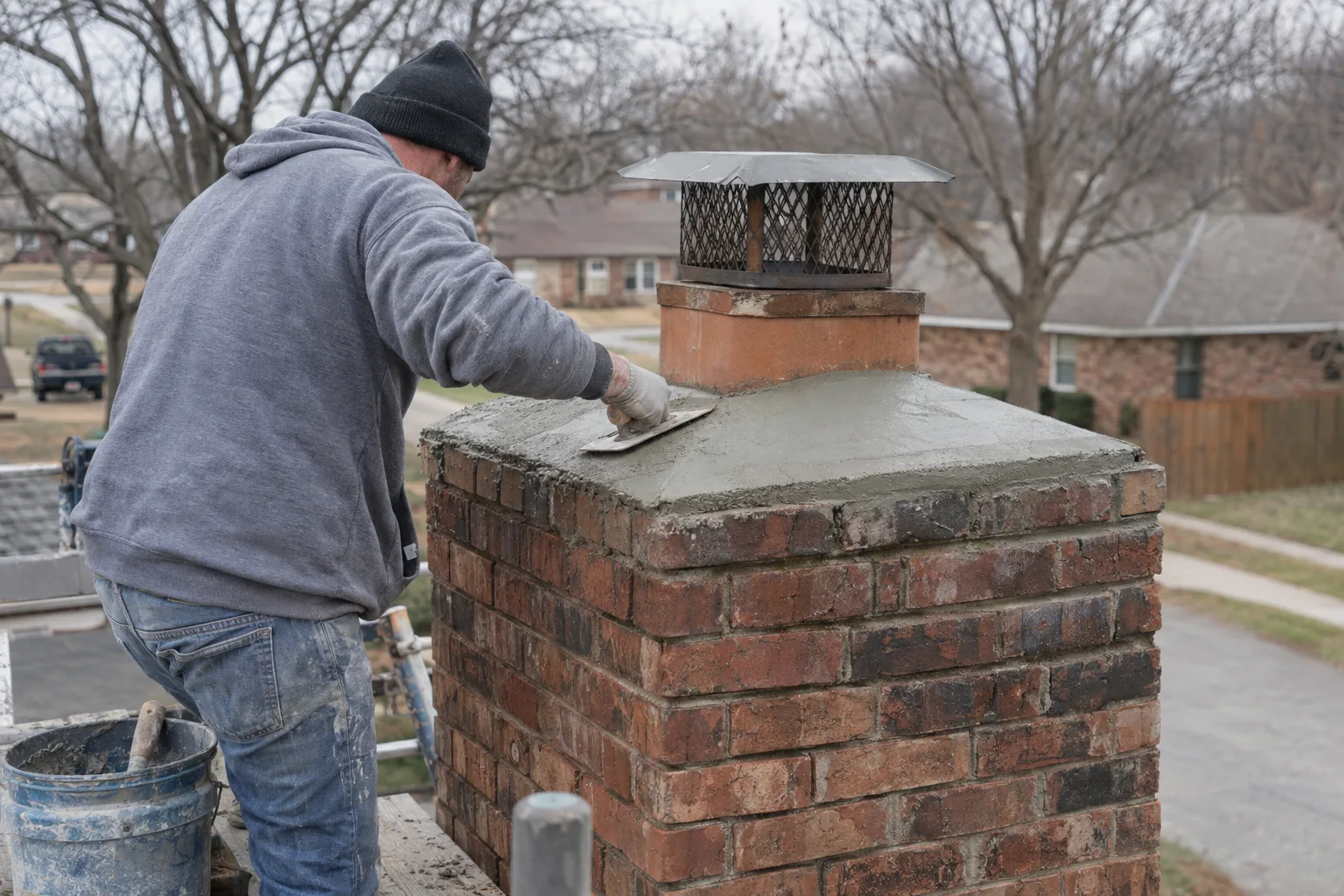
4. Concrete is mixed and poured on-site. Thickness at the outer edge is confirmed at minimum 2 inches before proceeding.
5. Slope is set and verified - ¼ inch per foot minimum toward the outer drip edge. This step doesn't get skipped.
6. The surface is tooled to final form and the flue collar area is sealed appropriately.
Post-Service Confirmation
Before we come down, the crew verifies slope with a level, checks that the drip edge overhang meets spec, and confirms the flue opening area is clean and unobstructed. We document the finished crown with photos. Curing guidance is provided - the homeowner knows exactly what to expect over the next 24 to 48 hours as the concrete sets.
Custom chimney crown installation in Oklahoma City is not a one-size process. Each chimney gets a pour built to its actual dimensions - and we don't leave until the specs are confirmed.
Areas We Serve in Oklahoma City
Oklahoma Chimney Sweep Pro serves chimneys throughout the Oklahoma City metro.
We work regularly across OKC neighborhoods including Midtown, Nichols Hills, Edmond, Moore, Yukon, Mustang, Piedmont, Bethany, Del City, Midwest City, and the broader south Oklahoma City growth corridors. If your chimney is in the OKC metro, we can get to it.
Ready for a Crown That's Built to Last Oklahoma City Winters?
A properly poured concrete chimney crown protects your entire chimney - not just the top. Oklahoma Chimney Sweep Pro has been doing this work in Oklahoma City since 2016. Our 10-person crew does this in-house, start to finish.
Call us at (405) 451-4866 or email info@okchimneysweep.com to schedule your chimney crown assessment. We'll get eyes on it and give you a straight answer on what it needs.