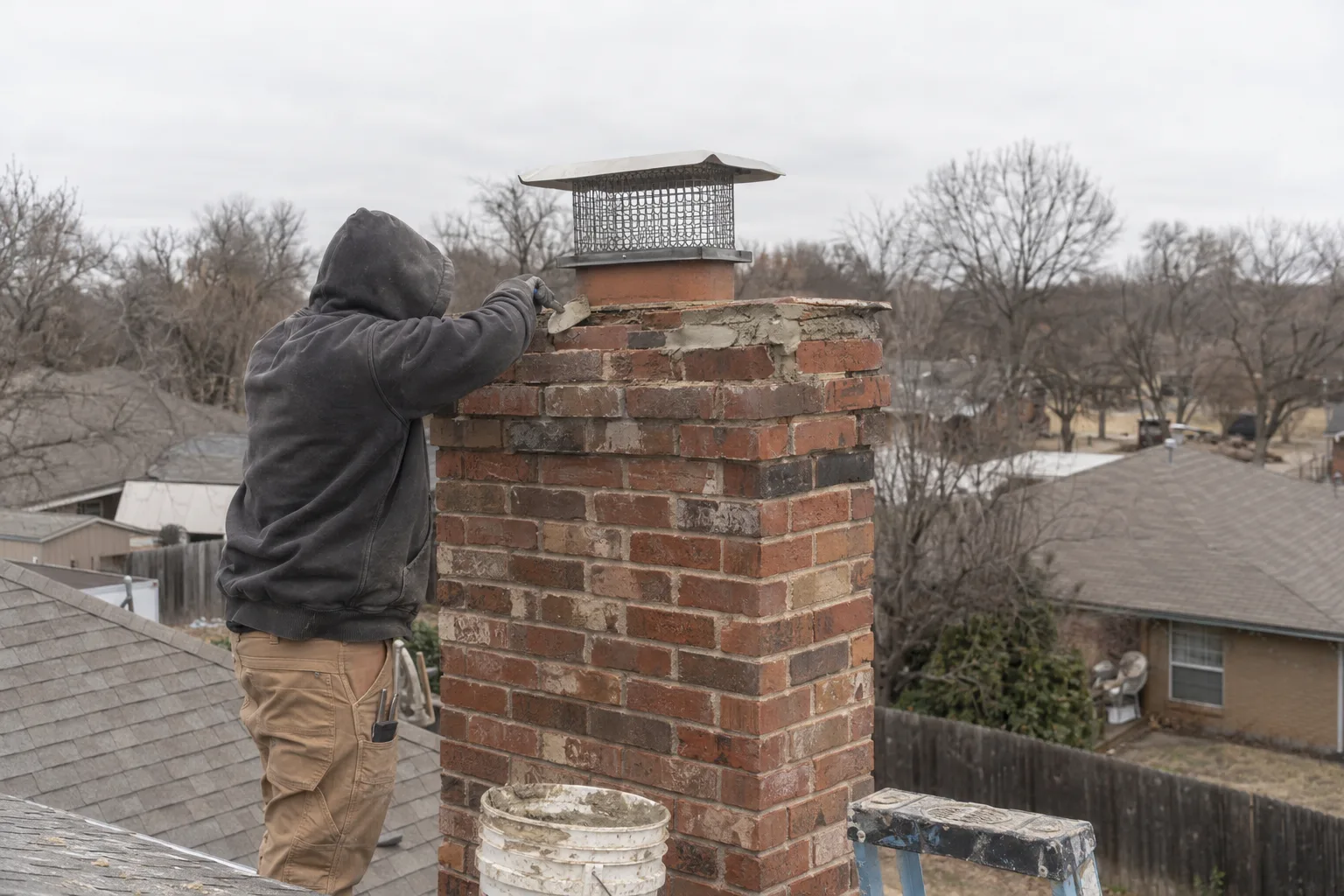
Oklahoma City's Weather Damages Chimneys Three Times a Year - in Sequence
Oklahoma City chimneys take hits from three distinct weather patterns every single year.
JFMAMJJASOND
- Freeze-thaw
- Hail
- Humidity
- Fall readiness
This page explains what each pattern does to specific chimney components and what you can look for on your own.
Why OKC's Location Makes Chimney Weather Damage Especially Predictable
Oklahoma City sits in a climate zone that delivers weather extremes back to back, year after year.
- Teens to 40sWinter swing, several times a week
- 50+Severe thunderstorm days a year
- Jul-AugHigh humidity soaks the masonry
Most U.S. markets have one or two primary weather stressors for masonry. Oklahoma City has three, and they arrive in an almost clockwork sequence each year.
Winter temperatures in OKC regularly swing from the low teens overnight to the mid-40s by afternoon. That swing - happening multiple times per week in January and February - is exactly what drives freeze-thaw cycle (masonry) damage. A freeze-thaw cycle is the process where water trapped inside mortar joints or crown surfaces expands when it freezes and contracts when it thaws. Those micro-movements crack masonry from the inside out.
Then spring arrives. OKC averages more than 50 severe thunderstorm days per year. Many of those storms produce hail. April through June is the core hail window for central Oklahoma - and chimney caps, flashing, and crown edges are fully exposed at the roofline.
Then summer. High humidity through July and August drives moisture absorption deep into brick and mortar. The masonry water absorption rate - meaning how quickly porous brick soaks up ambient moisture - accelerates in OKC's summer conditions. That absorbed moisture sits inside the masonry all season. When temperatures drop again in late fall, the water is already in place. The next freeze-thaw cycle starts from a wetter baseline than it would elsewhere.
That's the sequence. It's specific to this market, and it matters.
What Each Weather Pattern Actually Does to Your Chimney
Three weather events. Three damage types. Three different chimney components at risk.
February and March: Freeze-Thaw Cycles and Mortar Joint Recession
- Mortar joints
- Crown surface
Mortar joints are the thin lines of material between your chimney bricks. They're intentionally softer than the brick itself - that's by design. But that softness makes them the first point of failure in a freeze-thaw cycle.
Here's what most homeowners don't realize about mortar joints: once water finds a hairline crack and freezes inside it, the expansion pressure can be more than 2,000 pounds per square inch. That's enough to widen the crack noticeably in a single winter.
In OKC, late February is the worst window. You get multiple freeze-thaw cycles in a single week - cold nights followed by warm afternoons, over and over. Mortar begins to pull back from the brick face. Joints start to look slightly recessed. Eventually, gaps open wide enough that water enters the brick itself.
The chimney crown - the concrete cap at the very top of the chimney stack - takes similar abuse. Crown surfaces develop hairline cracks from repeated thermal expansion and contraction. Those cracks widen each winter. Left alone, they allow direct water entry into the flue.
From the ground, look for white streaking on brick surfaces. That's efflorescence - a visible signal that water is moving through the masonry and depositing mineral salts on the surface as it evaporates. It's not cosmetic. It's a diagnostic indicator.
April Through June: Hail Impact Damage to Caps, Flashing, and Crown Edges
- Chimney cap
- Flashing
- Crown edges
Hail impact damage to chimneys is one of the most overlooked post-storm issues in Oklahoma City. Homeowners check their roofs, their gutters, their vehicles. The chimney gets skipped.
But the chimney cap - the metal cover at the top of the flue - sits fully exposed at the highest point of your home. A golf ball-sized hailstone hits metal at significant force. Caps dent, louvers bend, and mesh screens deform. A dented cap no longer seats properly. Water and debris enter the flue.
Chimney flashing - the metal joint between the chimney base and the roof surface - takes hail hits differently. Impact can lift or crack the flashing seal. Even a small gap allows water to run behind the flashing and into the chimney chase or attic space.
Crown edges crack under direct hail impact too. A crown that looked solid in March may have chipped edges by June.
After any significant hail event in OKC, the chimney deserves a ground-level check. Look for cap displacement, visible dents from the yard, or new water staining inside the firebox.
Summer Humidity and Accelerated Masonry Absorption
Oklahoma City summers run hot and humid. Brick and mortar are porous. That combination matters more than most homeowners expect.
High relative humidity drives moisture into the masonry surface over weeks and months. The masonry water absorption rate climbs through July and August. That moisture doesn't evaporate quickly - it stays trapped in the material. Efflorescence - the mineral deposit left on brick surfaces when moisture moves through masonry and evaporates - becomes more visible in late summer for this reason.
More importantly, deeply absorbed summer moisture is still present when OKC's first hard freeze arrives. The chimney enters winter already saturated. Freeze-thaw damage that season is worse than it would be if the masonry had dried out over a dry summer. OKC doesn't get a dry summer. The cycle compounds.
Fall Readiness: What the Full Year Leaves Behind
By September, your chimney has been through all three weather phases. Mortar joints may have recessed. The crown may have new cracks. The cap may be dented or displaced. Flashing may be compromised.
None of these show up as smoke inside your home - until they do.
Weather-sequenced chimney damage is the pattern in which OKC's three primary weather stressors affect different chimney components at different times of year, producing cumulative damage that only becomes visible when all three cycles are assessed together. That assessment is exactly what a fall inspection covers.
Three Common OKC Scenarios - and What They Actually Look Like
These are the situations our crew documents repeatedly in Oklahoma City.
Freeze-thawScenario one
The post-March freeze-thaw gap.
A homeowner on the northwest side of OKC notices a white stain running down the brick face of their chimney every spring. It appears around March and fades by May. They've assumed it's harmless for three years. It isn't. Efflorescence that returns in the same location each spring means water is consistently moving through that section of masonry. Mortar joints in that area have almost certainly recessed enough to allow direct water entry. The fix - chimney mortar repair and repointing - is straightforward when caught early. Left three more years, the underlying brick begins to spall.
HailScenario two
The overlooked cap after April hail.
An OKC homeowner's neighborhood takes a significant hail event in late April. They file a roof claim, get the shingles replaced, and move on. By December, smoke rolls into the living room on the first cold night. A technician finds that a hailstone displaced the chimney cap during the April storm. Rain entered the flue all summer and fall, rusting the damper shut in a partially-closed position. The cap replacement would have been a minor cost in May. By December, the job also includes damper replacement and flue drying.
WindScenario three
Tornado Alley wind displacement.
Oklahoma City sits squarely in Oklahoma Tornado Alley - the geographic region in central Oklahoma where tornado frequency ranks among the highest in the world. Tornado-producing storm systems generate significant wind even at significant distances from the actual touchdown. Wind events routinely displace chimney caps without direct tornado contact. A homeowner sees storm coverage on the news, thinks "it missed us," and doesn't check the chimney. Wind-displaced caps leave the flue fully open to rain, nesting animals, and debris through the rest of storm season.
A Technician's View of What OKC's Weather Actually Does
Nine years in this market taught me to read OKC chimneys by season - not just by defect.
From Oklahoma Chimney Sweep Pro's crew:What I've learned is that OKC chimney damage has a rhythm. When I look at a mortar joint, I can usually tell whether the recession came from a single hard freeze or from three winters of gradual cycling. When I see a dented cap, I can tell by the dent pattern whether it was hail or wind.
We document everything with photographs - damage type, location, likely weather cause. Every homeowner we serve gets a written condition report that ties what we found to OKC's weather calendar. That documentation has helped customers file insurance claims and helped them understand what they're looking at, not just what it costs to fix.
The chimneys that hold up best in this market aren't the newest ones. They're the ones that get inspected before burn season - every year, after three rounds of weather stress.
When to Bring in a Professional for Climate-Related Chimney Damage
Bring in a pro when the damage goes beyond what's visible from ground level.
A storm season chimney checklist - a structured post-storm review of cap, crown, flashing, masonry surface, and mortar joints - is a reasonable starting point after any significant weather event. From the ground, look for:
- White staining or streaking on brick surfaces (efflorescence signals moisture movement)
- Displaced or visibly dented chimney cap
- Visible crown cracking or chipped edges at the chimney top
- Mortar joints that look recessed, dark, or hollow
- Water staining inside the firebox after a rain event
If you see any of those, a professional inspection is the right call. Why?
Because what's visible from the ground is rarely the full picture. Flashing gaps, interior crown cracking, and mortar recession deeper in the joint all require close access to assess. A thermal expansion crack - a crack in masonry caused by the wide temperature range OKC delivers - can look stable from 20 feet away and be actively channeling water at the surface.
After nine years and three storm seasons per year in Oklahoma City, our team knows what to look for. We arrive, document what we find, and give you a written condition report before any repair conversation starts.
Areas We Serve in Oklahoma City
Oklahoma Chimney Sweep Pro serves Oklahoma City and the surrounding communities.
Our 10-person crew covers the full OKC metro, including neighborhoods across the northwest, northeast, south, and central corridors. If you're in the Oklahoma City service area, we can schedule a documented chimney condition review. Call us at 405-451-4866 or email info@okchimneysweep.com to confirm your address.
- Northwest OKC
- Northeast OKC
- South OKC
- Central OKC